

How Much Does a Land Survey Cost in Virginia?
September 4, 2026Buying a home is one of the largest financial decisions most people will ever make. During the process, buyers spend considerable time reviewing inspection reports, mortgage documents, disclosures, appraisals, insurance requirements, and closing paperwork. Yet one important question can easily be overlooked: Do you need a land survey before buying a house in Virginia?
A land survey helps you understand exactly what you are purchasing. The house itself may be easy to see, but the legal boundaries of the property are not always as obvious. A fence may look like it follows the property line when it actually sits several feet onto a neighboring parcel. A driveway may cross an easement. A shed, patio, garage, retaining wall, or other improvement may be positioned differently than a buyer assumes. Even when a property has changed hands several times without an obvious issue, that does not necessarily mean the physical use of the land perfectly matches the legal boundaries.
For Virginia homebuyers, a professional land survey can provide valuable information before the purchase is complete. It can identify property lines, locate improvements, reveal potential encroachments, and provide a clearer picture of the land associated with the home. Whether a survey is required in a particular transaction can depend on the lender, title company, property, and circumstances, but buyers should understand what a survey provides before deciding whether to move forward without one.
What Is a Land Survey?
A land survey is a professional measurement and evaluation of a parcel of real estate performed by a licensed land surveyor. The surveyor researches available property records, reviews relevant plats and deeds, performs field measurements, evaluates physical evidence on the property, and determines the location of the property’s boundaries based on the available legal and physical information.
The resulting survey can show much more than the outline of a lot. Depending on the type and purpose of the survey, it may identify structures, fences, driveways, easements, rights-of-way, apparent encroachments, and other features that may affect the way the property is used. This information can be especially important before a real estate closing because buyers are not simply purchasing a house. They are purchasing a specific parcel of land with legally defined limits.
Many homeowners naturally rely on visible features to understand their property. A fence appears to mark the backyard. A row of trees seems to divide neighboring lots. A driveway looks like it belongs completely to one home. Those visual assumptions may be correct, but only a professional survey can establish the property boundaries with the level of precision needed when ownership, construction, or potential disputes are involved.
Is a Land Survey Required When Buying a House in Virginia?
A land survey is not automatically required in every Virginia home purchase simply because ownership is changing. Whether one is requested or required can depend on the mortgage lender, title company, type of financing, age of existing survey information, property characteristics, and circumstances surrounding the transaction.
That is an important distinction. Something does not have to be legally required in every transaction to still be valuable to the buyer.
A home inspection, appraisal, title search, and land survey each answer different questions. An appraisal primarily helps determine value for lending purposes. A home inspection evaluates the physical condition of the house and its major systems. A title search examines ownership records and matters affecting title. A land survey addresses the physical location and dimensions of the property itself.
A buyer who skips the survey may therefore complete several other important forms of due diligence while still lacking precise information about where the property begins and ends.
Why a Previous Survey May Not Tell the Whole Story
One of the most common reasons buyers question whether they need a new survey is that the seller already has an old one. An existing survey can certainly be useful, particularly when it provides historical information about the property, but buyers should be cautious about assuming an older survey reflects everything currently on the ground.
Properties change over time. Fences are installed. Sheds are added. Driveways are widened. Decks, pools, additions, retaining walls, patios, and landscaping features may be constructed years after an older survey was completed. Adjacent properties may also change, creating new questions about boundaries or encroachments.
Even when the legal description has not changed, the physical relationship between the boundary and the improvements may have.
A current survey allows the property to be evaluated based on present conditions rather than relying solely on a document showing what existed years ago. If a previous survey is available, provide it to the surveyor. It may be valuable during the research process, but the existence of an old document does not automatically eliminate the reasons for obtaining updated information.
Property Lines Are Not Always Where They Appear to Be
One of the primary reasons to obtain a land survey before buying a house in Virginia is to confirm the property’s actual boundaries.
Buyers commonly assume that fences, landscaping, utility poles, ditches, or other visible features follow property lines. Sometimes they do. Sometimes they do not.
A fence may have been intentionally installed several inches or feet inside the owner’s boundary. A previous homeowner may have installed landscaping based on an incorrect assumption about the property line. An adjacent driveway may extend slightly across a boundary. In older neighborhoods, long-standing patterns of use may make the physical division between properties appear obvious even though the legal boundary lies elsewhere.
These issues may never become a serious dispute, but discovering them before closing gives a buyer more information than discovering them years later when planning a fence, addition, garage, or other improvement.
Knowing where your property actually ends is much more useful than simply knowing where everyone has historically assumed it ends.
A Survey Can Reveal Potential Encroachments
An encroachment occurs when a structure or improvement extends across a property boundary onto neighboring land or when an improvement from the neighboring property extends onto the parcel being purchased.
Encroachments can be obvious or extremely subtle.
A large garage built across a property line would be noticeable. A fence extending several inches beyond the boundary may not be. Other examples can involve sheds, driveways, retaining walls, landscaping features, decks, patios, or portions of other improvements.
When buyers understand these conditions before closing, they have an opportunity to ask questions and determine whether any additional investigation or resolution is appropriate.
The value of a survey is not that it automatically solves every property issue. Its value is that it provides accurate information so buyers, sellers, title professionals, attorneys, lenders, and other parties can make decisions based on what actually exists.
Easements Can Affect How You Use Property
Property ownership does not necessarily mean every part of a parcel can be used without restriction.
An easement gives another party certain rights to use or access a portion of property for a specific purpose. Utility easements, drainage easements, access easements, and other recorded rights can affect where improvements may be placed and how certain areas of land can be used.
For example, a buyer may purchase a home with plans to build a detached garage, install a pool, expand a driveway, or construct a fence. If the preferred location overlaps an easement, those plans may need to be reconsidered.
A survey can help illustrate the relationship between property boundaries, existing improvements, and certain easements shown through the available property records.
This can be especially useful for buyers who already know they want to improve the property after closing. Understanding the land before purchasing it provides a much stronger starting point than discovering restrictions after designs, deposits, or construction plans are already underway.
Buying a Home With a Fence? Do Not Assume It Marks the Boundary
Fences create one of the most common misunderstandings surrounding residential property lines.
A buyer walks through the backyard, sees a complete fence, and naturally thinks, “This is the property.” Yet the fence itself does not establish ownership. It may follow the boundary accurately, it may sit within the boundary, or portions of it may extend beyond the legal property line.
That becomes particularly important if the buyer plans to replace or modify the fence later.
Installing a new fence based entirely on the location of an existing fence can repeat an old mistake. A professional boundary survey gives the homeowner better information before a new fence project begins.
This is also why surveying can be valuable before purchasing a home with a very large yard or an unusual lot shape. The farther the apparent boundaries extend from the house, the harder it may be to judge exact limits visually.
A Survey Can Matter Before Building an Addition
Many buyers choose a home partly because of what they plan to do with it later.
Perhaps the house has room for a screened porch. Maybe the backyard seems perfect for a detached garage, pool, accessory structure, or expanded patio. A buyer may envision adding square footage to the home several years after moving in.
Those plans make accurate boundary information even more valuable.
Building projects can be influenced by property lines, setbacks, easements, zoning requirements, subdivision restrictions, and other considerations. A survey provides the accurate physical information that owners and design professionals need when evaluating where improvements can be placed.
A buyer who knows major improvements are part of the future plan may therefore want to understand the property before closing rather than discovering an unexpected boundary or site limitation after purchasing the home.
Surveys Can Help With Irregularly Shaped Lots
Not every property is a simple rectangle.
Virginia includes everything from dense urban neighborhoods and suburban subdivisions to rural acreage, waterfront parcels, wooded properties, and older lots with complex legal descriptions. Property lines may change direction several times, follow unusual geometry, or extend through areas where no obvious physical marker exists.
This can make visual assumptions particularly unreliable.
On an irregular parcel, the backyard may appear to extend in one direction while the actual line angles significantly. A wooded property may include acreage that is difficult to interpret without professional equipment. A corner lot can contain more complicated frontage and setback considerations than a buyer expects.
A professional land survey transforms those assumptions into measurable information.
Surveys Are Especially Useful When Buying Vacant Land
The importance of surveying becomes even more obvious when purchasing vacant land.
With an improved residential property, the house itself provides at least one major visual reference point. Vacant land may provide very few. A buyer may be standing on several acres of wooded or open property with no obvious indication of where one parcel stops and another begins.
When purchasing vacant land, buyers may need to understand boundaries before evaluating building locations, access, driveway placement, clearing, utilities, or future improvements.
The fact that a real estate listing describes a parcel as containing a certain amount of acreage does not tell you exactly where that acreage lies on the ground.
A boundary survey can help connect the legal description of the land with its physical location, giving buyers a much clearer understanding of what they are purchasing.
What About New Construction?
Buyers purchasing newly built homes may assume that surveying is unnecessary because the property has only recently been developed.
Newness does not eliminate the need for accurate property information.
New subdivisions involve recorded plats, newly created lots, building setbacks, easements, roads, utilities, drainage infrastructure, and improvements constructed according to approved plans. A survey can provide useful documentation of how the completed property relates to its legal boundaries.
This may be especially relevant if a buyer plans to install a fence, pool, patio, or other improvement shortly after moving in.
The fact that a house is new does not mean a homeowner should rely solely on a sales brochure, site plan, marketing map, or visual estimate when making decisions about the property line.
A Survey Is Different From a Plat
Buyers frequently encounter a subdivision plat during a real estate transaction and assume it is equivalent to a survey of their individual property.
A plat and a current boundary survey serve different purposes.
A recorded subdivision plat can show how a larger tract of land was divided into individual lots, roads, easements, and other features. It is an important land record, but it does not necessarily show the current physical conditions on a particular lot.
A current survey involves professional research and fieldwork related to the individual property. It connects record information with evidence and measurements found on the ground.
This distinction matters when trying to determine whether an existing fence, shed, driveway, house addition, or other improvement relates correctly to the legal boundary.
The plat provides valuable context. The survey applies that information to the property as it exists.
A Deed Does Not Replace a Land Survey Either
A deed is another essential real estate document, but it does not serve the same purpose as a survey.
The deed establishes ownership and typically contains or references the legal description of the property being conveyed. That description is extremely important, but most buyers cannot stand in the backyard with a deed and determine exactly where the boundary runs.
A land survey interprets the relevant property records and connects the legal description to physical measurements in the field.
In simple terms, the deed helps establish what property is being conveyed, while the survey helps determine where that property is located on the ground.
Both documents can be important parts of understanding real estate, but they are not interchangeable.
Why Home Inspections Do Not Identify Property Boundaries
Homebuyers commonly invest in a professional home inspection before closing, and for good reason. An inspector can identify concerns involving roofing, electrical systems, plumbing, HVAC equipment, structural components, moisture, and many other elements of the house.
However, a home inspector is not performing a boundary survey.
The inspector may point out visible concerns involving fences, grading, drainage, retaining walls, or exterior improvements, but that does not establish where the legal property line is located.
A home can receive an excellent inspection while still having a boundary issue.
The two services answer completely different questions, and buyers should not assume one replaces the other.

Why an Appraisal Does Not Replace a Survey
A mortgage lender may order an appraisal to evaluate the property’s market value and determine whether it supports the amount being financed.
Although appraisers consider many aspects of the property, an appraisal is not the same as a professional boundary survey.
An appraisal may reference lot size, property records, and visible site characteristics, but it generally does not involve establishing the legal boundary through the same research and field measurement process performed by a licensed land surveyor.
This distinction is particularly important because buyers may assume that if the lender ordered an appraisal, every major question about the property has been verified.
The lender’s valuation process and the buyer’s need to understand exact property boundaries are separate considerations.
What Happens During a Residential Boundary Survey?
The surveying process generally begins with research.
The surveyor reviews relevant deeds, plats, previous survey information when available, and other records that can help establish the property’s boundaries. This research is important because land surveying is not simply a matter of measuring from the nearest fence or structure. Surveyors evaluate the record evidence associated with the parcel.
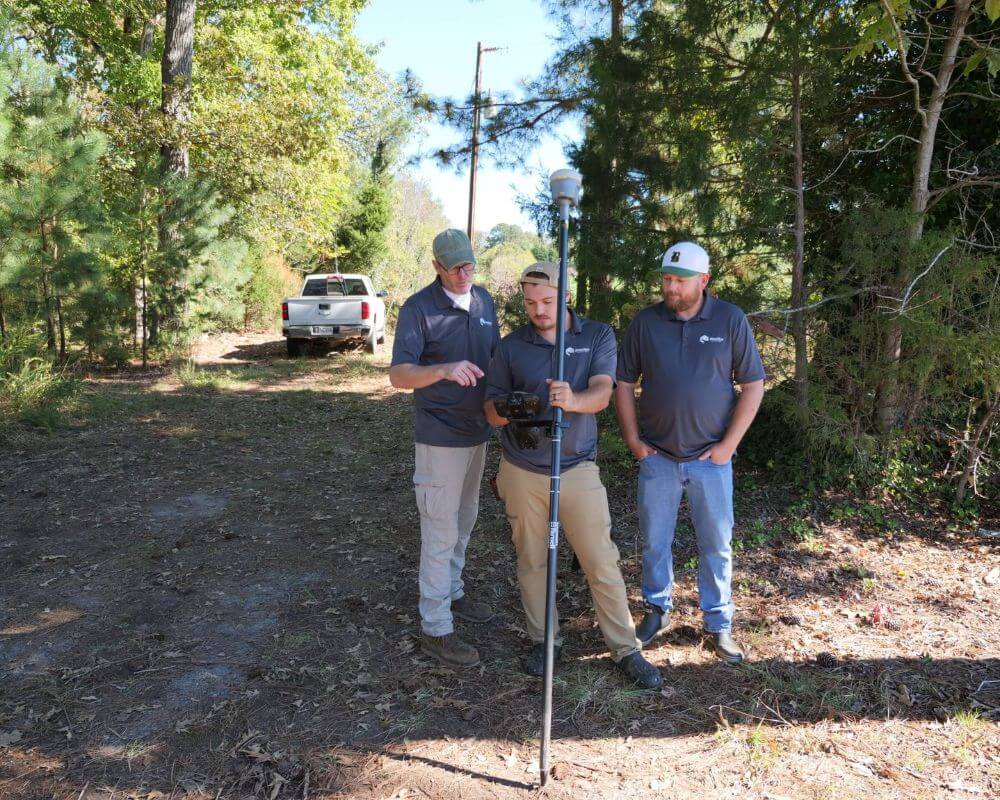
The field portion involves visiting the property and gathering measurements using professional surveying equipment. Existing monuments, physical evidence, improvements, and other relevant site features may be located and evaluated.
The surveyor then uses the collected information together with the property records to determine and document the boundary.
Depending on the service requested, the final survey may show boundary lines, dimensions, improvements, apparent encroachments, and other relevant features.
For buyers, the result is something extremely valuable during a real estate transaction: greater clarity about the property itself.
When Should You Order a Survey During the Buying Process?
If you decide to obtain a land survey before purchasing a house, earlier is generally better than waiting until the final moments before closing.
Surveyors need time for property research, scheduling, fieldwork, calculations, and preparation of the final deliverable. Some properties are relatively straightforward, while others require more extensive research or field investigation.
Waiting until immediately before closing can create unnecessary pressure, especially if the survey identifies something that deserves additional review.
Buyers should communicate with their real estate agent, lender, title company, attorney when applicable, and surveyor to determine how a survey fits within the transaction timeline.
If a lender or title company has specific survey requirements, those requirements should be communicated clearly when requesting the work.
Who Pays for a Land Survey When Buying a House?
Who pays for a survey can vary depending on the transaction and any agreement between the buyer and seller.
In many situations, the buyer orders and pays for the survey because the buyer wants updated information about the property being purchased. In other transactions, responsibilities may be negotiated or handled differently.
Rather than assuming the seller will provide one, buyers who want a current survey should discuss that expectation early in the transaction.
The cost of surveying should also be viewed in the context of the larger purchase. A home may represent hundreds of thousands of dollars in value. Accurate information about the boundaries of that investment can be an important form of due diligence.
How Much Does a Land Survey Cost in Virginia?
There is no single price for every land survey because the amount of work required can differ significantly from one property to another.
Survey costs may be influenced by parcel size, lot configuration, terrain, vegetation, availability and quality of existing property records, the type of survey being requested, travel requirements, and the complexity of the boundary.
A smaller residential lot in a clearly documented subdivision may involve very different work from a large rural property with difficult terrain and complicated historical records.
For the most useful pricing information, provide the surveyor with the property address and explain why you need the survey. This allows the surveying company to research the property and recommend the appropriate service rather than giving a generic estimate that may not fit the actual project.
What If the Survey Finds a Problem?
Finding an unexpected condition on a survey does not automatically mean the property should not be purchased.
It means you have information.
Depending on what the survey identifies, you may want to discuss the matter with the appropriate professionals involved in the transaction. That could include your real estate agent, attorney, lender, title company, seller, or other qualified professional depending on the nature of the issue.
The appropriate response to an encroachment, easement concern, access question, or boundary discrepancy depends on the facts.
The advantage of discovering the condition before closing is that you have an opportunity to understand it while the transaction is still underway.
Discovering the same issue several years later, perhaps when applying for a permit or preparing to sell the property, may leave you wishing you had known about it sooner.
Should You Get a Survey Even If Your Lender Does Not Require One?
A lender’s requirements and a buyer’s due diligence are not always the same thing.
A lender is primarily concerned with protecting its financial interest in the property and ensuring the loan meets its requirements. A buyer has a broader interest. You will be living on the property, maintaining it, making improvements, and eventually selling it.
That means a buyer may choose to obtain a survey even when it is not specifically required by the lender.
The decision becomes particularly worth considering when the property has fences, additions, detached structures, shared driveways, unusual lot lines, acreage, visible boundary uncertainty, or planned improvements.
It can also be valuable simply because you want to know exactly what you are buying.
Buying a Home in Richmond, Norfolk, or Elsewhere in Virginia
Virginia property can vary dramatically depending on where you buy.
An established Richmond neighborhood may contain older plats, mature landscaping, additions, garages, fences, and property lines that have been treated the same way for generations. Hampton Roads and Norfolk-area properties may involve dense development, coastal considerations, older neighborhoods, and unusual lot configurations. Suburban communities throughout Central Virginia may include modern recorded subdivisions with easements, common areas, and detailed development plans. Rural parcels can introduce acreage, wooded boundaries, access questions, and long distances between visible property markers.
This variety is one reason local surveying experience matters.
A surveyor should be able to research the relevant property records and accurately connect that information to conditions on the ground, whether the project involves a compact residential lot or a larger tract of Virginia land.
Questions to Ask Before Hiring a Land Surveyor
When requesting a survey for a real estate purchase, start by explaining exactly why you need the work. Tell the surveyor that you are buying the property and describe any particular concerns, such as an existing fence, planned addition, driveway, acreage question, or potential boundary issue.
Ask what type of survey is appropriate for your situation, what information you should provide, how the results will be delivered, and the expected timeline.
If your lender, attorney, or title company has provided specific requirements, share them with the surveyor before work begins.
Choosing the correct surveying service at the beginning is much easier than discovering later that another type of documentation is needed.
When Might a Buyer Need an ALTA/NSPS Land Title Survey?
Most residential homebuyers will not automatically need an ALTA/NSPS Land Title Survey. ALTA surveys are most commonly associated with commercial property transactions, lenders, title insurers, developers, and other transactions requiring a highly standardized level of survey information.
However, more complex property transactions can involve different surveying requirements, so buyers should follow the specifications provided by their lender, attorney, title company, or other transaction professionals.
James River Surveying provides both residential boundary surveying and ALTA surveying, which allows the appropriate service to be matched to the needs of the property and transaction.
The important thing is not to assume every survey is identical. Explain the purpose of the survey when requesting a quote so the surveying team can understand what you actually need.
Frequently Asked Questions About Land Surveys Before Buying a House in Virginia
Do I need a land survey before buying a house in Virginia?
A survey may not be mandatory in every Virginia residential purchase, but it can provide valuable information about the property’s boundaries, improvements, easements, and possible encroachments. Whether a survey is required can depend on the lender, title company, transaction, and property.
Does a mortgage lender always require a land survey?
No. Requirements vary among lenders, loan programs, title companies, and transactions. Buyers should ask the professionals handling their purchase whether a survey is required and consider whether obtaining one makes sense for their own due diligence even if the lender does not require it.
Can I use the seller’s old survey?
An older survey may provide useful information, but it may not reflect improvements or changes that occurred after it was completed. Fences, additions, sheds, driveways, patios, and neighboring improvements can all change over time. A current survey evaluates the property based on present conditions.
Is a plat the same as a land survey?
No. A plat can show recorded lots, roads, easements, and other information associated with a subdivision or property, while a current boundary survey uses professional research and field measurements to determine the property’s boundary and relevant existing conditions.
Does a home inspection show property lines?
No. A home inspection evaluates the condition of the house and its systems. It does not establish legal property boundaries. A licensed land surveyor performs the research and measurements necessary to determine those boundaries.
Can a land survey show if a neighbor’s fence is on my property?
A boundary survey can determine the property line and locate relevant visible improvements such as fences, allowing their relationship to the boundary to be evaluated.
Should I get a survey before buying vacant land?
A survey can be particularly valuable for vacant land because property limits may be difficult or impossible to identify visually. Buyers considering construction, access, clearing, or other future improvements benefit from understanding the location of the parcel they are purchasing.
How long does a land survey take?
Survey timelines vary depending on the type of survey, property complexity, available records, field conditions, current workload, and other project-specific factors. Buyers should contact the surveyor as early as possible if the survey must be completed before a scheduled real estate closing.
Know What You Are Buying Before You Close
Buying a house involves more than evaluating bedrooms, kitchens, roofs, and mortgage rates. You are also purchasing a specific piece of Virginia land, and understanding the boundaries of that land can be an important part of protecting your investment.
A professional land survey can provide clarity about property lines, existing improvements, possible encroachments, and other physical conditions that may not be obvious during a walkthrough. It can also give you better information before planning future fences, additions, garages, pools, patios, or other improvements.
Even when a survey is not required for a particular transaction, it may still be worthwhile for a buyer who wants greater confidence in exactly what is being purchased.
James River Surveying provides professional boundary and property line surveys for homeowners, buyers, landowners, and real estate professionals throughout Virginia. If you are purchasing a home or property and want to understand your boundaries before closing, contact James River Surveying with the property address and reason for the survey to get started.
Know where your property begins before you make it yours.